The practice, section by section
Preliminaries to the Practice of Dhyana
Dhyana is practical, not esoteric. The teaching sets out to remove the idea that it is a mysterious path for a chosen few.
Shri Swamiji guides seekers chiefly through dhyana yoga. Because it is widely thought to be obscure, people hesitate to start, and even those who begin often carry doubts — sometimes made worse by teachers who pose as advanced practitioners. This chapter answers those doubts with practical method rather than philosophy, because in dhyana yoga practice comes first and theory follows: as the meditation deepens, the practitioner comes to understand the truths behind it of themselves.
Dhyana Diksha — Initiation into Dhyana
At initiation, the aspirant is touched between the eyebrows and sits for about an hour of meditation while the Guru is present. Through the touch and the Guru’s gaze, the teaching says, spiritual power is transmitted to help the practitioner’s later sadhana.
The aspirants sit facing Shri Swamiji with their eyes closed. A disciple, having received the Guru’s blessing, touches each person at the bhrikuti — the point between the eyebrows — and tells them to concentrate there. The group then meditates for roughly an hour.
Many people report a spiritual experience during this hour: seeing colours, seeing light, or seeing a vision of their chosen deity. Where no vision comes, the account attributes it to something in the practitioner — not enough faith, an inability to keep the eyeballs steady at the brow, a mind too scattered for one-pointed concentration, or restlessness that makes the eyes open and breaks the focus. Those with no earlier training in meditation almost inevitably make such mistakes, so vivid experiences are unlikely at first. Those who do steady both sight and mind at the bhrikuti usually receive the experience as a brief flash near the end of the sitting. Whether or not a vision occurs, nearly everyone feels a deep peace — taken as a clear sign of the diksha’s benefit.
Shri Swamiji gives no mantra initiation, for two reasons the text records: a mantra is not needed for the meditation he teaches; and for a practitioner whose disposition does call for one, the right mantra is said to arise of itself during regular practice.
Use of Vibhuti
The vibhuti — sacred ash — blessed by Shri Swamiji at initiation is to be treated as supremely sacred.
If it is accidentally spilled or defiled, the teaching says, it loses its potency. Before each meditation session the practitioner should honour this vibhuti briefly — with incense and coconut — and then apply a tikka of it at the bhrikuti before sitting. During illness, the account advises taking a little vibhuti mixed with water.
Time for Dhyana
Meditation may be done at any time, but Shri Swamiji recommends sittings of at least one hour, and above all regularity.
In the early stages nearly the whole hour is needed just to bring sight and mind to rest at the bhrikuti. Since real meditation only begins once that stillness is reached, sitting briefly and rising again is called self-deception. The true measure is not the clock but the time each person needs to reach one-pointedness (ekagratha) and then to hold the meditative state for fifteen to thirty minutes afterwards; the practitioner is the best judge of that.
Serious practitioners are told to lengthen their meditation only gradually, in step with their development — eventually aiming at ten to twelve hours a day, not necessarily unbroken but in periods of two to four hours to suit their capacity — and never to force long sittings.
Early morning and dusk are the best times, when the mind settles naturally; those who cannot sit then may choose another time. Whatever hour is chosen, keeping it fixed each day is desirable, because a habitual time creates its own urge to meditate, “similar to experiencing hunger at regular mealtimes.” More important than a fixed hour, though, is consistency itself: a single missed day, the text says, can take seven to ten days to recover.
Place of Dhyana
Meditation should be done in a secluded, quiet place, free from the disturbance of people coming and going or talking nearby. A darkened room assists the practice.
Asana — Posture
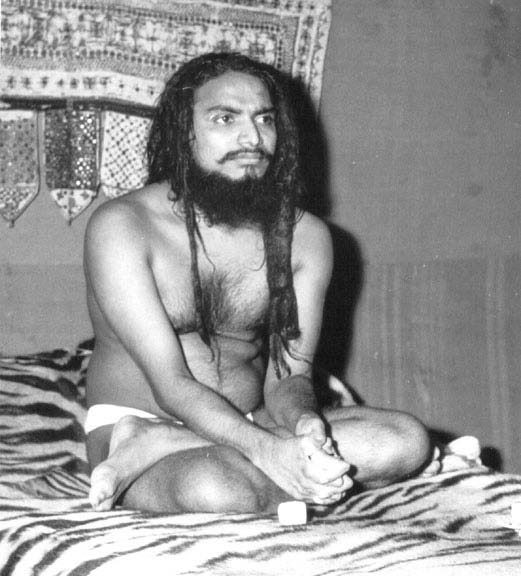
The recommended postures are Padma Asana, Siddha Asana or Veer Asana; anyone who finds these difficult may take a comfortable position instead.
- The spine is kept erect.
- The body’s weight is spread evenly across the underside of the thighs and buttocks; leaning the weight too far back burdens the spine and brings quick fatigue.
- The body stays completely relaxed, with no artificial tautness anywhere — tightness causes muscular fatigue, cramps and pain.
- The face is kept level or turned slightly upward, never drooping downward, which makes concentration hard to hold and invites sleep.
If fatigue or pain makes a steady posture impossible, the practitioner may change asana while continuing to meditate — taking care not to break the concentration of sight and mind at the bhrikuti, and especially not the focus of sight, during the change.
Physical Fitness and Diet
Sound health is treated as essential, since bodily ailments distract the mind and prevent concentration.
Long practice needs bodily strength and energy, so a nutritious, balanced and moderate diet is advised. Meditation goes best on an empty or light stomach; an overloaded stomach brings mental and physical dullness. After a long sitting, the practitioner should take milk or a light refreshment and rest a little before returning to other activity.
The Technique of Dhyana
The technique is described here step by step. In practice, the teaching says, the transmitted power does much of this of itself once the practitioner surrenders and keeps up steady practice.
Lakshaya — the aim of dhyana
Any serious quest needs a clear aim from the start, or the seeker falters and strays. The scriptures, the text says, hold that the mind is what binds, and that manonasha — the ending of the mind — is liberation. Examined closely, the mind is only a bundle of thoughts; when its thought-waves are no longer fed, it subsides and dies, “just as a fire is automatically extinguished if not fed with fuel” (the account cites the Devikalottara). The aim of dhyana, then, is to still the mind by letting go of every thought. When thoughts cease, only chit — pure awareness — remains; resting the whole mind steadily on that residual awareness, undisturbed by even a trace of thought, is said to bring Atman Sakshatkara, Self-realisation, of itself.
Steadying the vision
Meditation begins by stilling the movement of the eyeballs, the gaze fixed at the bhrikuti. Beginners often try to do this by forcing the eyes inward, which strains the muscles, sets the eyeballs quivering and, with repetition, brings headaches — clearly the wrong way. Instead the stilling should come gradually and naturally, with a steady, strain-free gaze at that spot until sight rests there without any flicker of eyeball or eyelid. This is called an essential preliminary; without it, no further progress is possible. At first it may take fifteen to twenty minutes. With regular practice the power given by Shri Swamiji at initiation begins to assist — felt first as a heaviness of the eyelids, and later as an almost forcible drawing of the sight to the bhrikuti, holding it there.
Stilling the mind
The mind flows outward through the brain and the senses, taking the shape of the world’s names and forms. That outward flow, in its countless thought-forms, has to cease, so that the mind becomes one-pointed (ekagratha). This is done by gathering the whole mind at the bhrikuti and then not letting a single thought arise — not even the thought “I am meditating.”
Concentration on chit
When sight and mind are still and one-pointedness is reached, names, forms and thoughts fade and only chit, pure consciousness, is left. It has no form the mind can grasp; it is the bare awareness of existence, of “I am,” that remains when the thought-forms are gone. At first this is like gazing into emptiness — a blank darkness; then the darkness gives way to light, like looking into a lit crystal or a blazing luminous mass.
Commencement of dhyana
Only when one-pointedness on pure chit is reached does meditation actually begin; everything before that is preparation and should not be mistaken for meditation itself. Having reached it, the practitioner tries to remain there, unbroken by a single thought-wave. Properly understood, meditation is this continuous effort to stay in pure awareness; its excellence lies in not letting even the idea “I am meditating” disturb it. Thoughts driven by purva samskar — inherited tendencies — will keep rising to break the flow; the practitioner stays alert and gently brushes each aside, keeping the mind still “like a lamp in a windless place” and the flow unbroken “like a continuous flow of oil.”
The Guru’s grace
The steps above describe the process as a sequence. But through purna sharanagati — complete self-surrender at the Guru’s feet — together with unwavering practice, the power given at diksha begins to develop in the practitioner, and then the whole preliminary process accomplishes itself. The practitioner has only to quieten the mind and surrender; the shakti then takes over, drawing sight and mind to the bhrikuti and holding them there. When the mind stirs, the sight flickers, or the eyes or forehead feel tight, these are read as signs of resistance to the power through passing thoughts; the moment the thoughts settle, the symptoms go and the shakti resumes its work.
Problems and Misconceptions Common to Beginners
The account devotes a long section to the difficulties everyone meets, so that they are recognised as normal and not taken as failure.
The turbulence of the mind
A restless, churning mind is the universal first experience — likened to the churning of a whole ocean of vasanas, latent tendencies. The two remedies given are vairagya (dispassion), cultivated steadily, and abhyas (persistent practice). For acute agitation, a little pranayama is suggested; if it still persists, the practitioner is told to pause and read scripture or sing bhajans rather than fight the mind.
Strain, and “diving deep”
Knitting the brows or looking forcibly inward only causes strain and headaches. Concentration is entirely mental; “diving deep” means turning the outward-facing mind inward, not searching somewhere inside the body.
Japa and visualisation during dhyana
Repeating a mantra or picturing a chosen deity during dhyana are themselves obstacles — they are still thoughts. They may be used at the very start to calm the mind, but must be dropped once it has settled.
The mental eye and the mental ear
Beyond the physical senses, the text says, are inner organs that form images and inner speech. Keeping the sight concentrated at the bhrikuti prevents the mental pictures — and the mental talk that goes with them — from forming.
Progress in the early stages
At first the practitioner gets only seconds of thoughtlessness. With persistence those moments grow longer and more frequent — and that increase is itself the measure of progress.
Obstructions to dhyana
- Sleep. A natural response when the vasanas are being suppressed; the advice is to allow full sleep until the need is satisfied, after which the urge to sleep during meditation lessens.
- The bliss of manolaya. The mind’s temporary subsidence brings peace, but it is only an intermediate stage. The true aim is manonasha, the ending of the mind so that it does not rise again.
- Shunya, the void. When thoughts stop, an apparent blankness appears. Understanding that an awareness still witnesses that blankness turns the inquiry toward the Atman as the witness.
- Mistaking somnolence for dhyana. Passively drifting is not meditation. In real dhyana the mind is intense and vigilant — like a spinning top, apparently still but inwardly active.
The influence of the three gunas
Sattva (clarity, peace, dispassion), Rajas (desire, anger, ambition) and Tamas (dullness, laziness) take turns colouring the mind. The practitioner is to cultivate Sattva — overcoming Tamas by means of Rajas, then quietening Rajas through Sattva.
The baneful influence of Tamo Guna
Early enthusiasm fades as the other gunas assert themselves, and periods of dryness, doubt and even despair arise. Persisting through these dark moods, the text says, is what produces the greatest progress; the struggle is part of the path.
Heated brain and headaches
These come from wrong technique or from an unconscious resistance to the discipline. The remedy is to relax and stop forcing the concentration, replacing mental strain with the gentle deflecting of thoughts.
Attainments through Dhyana Sadhana
The signs of progress described here are inward, and the text is careful to call several of them side-effects rather than goals.
How progress is measured
The changes are not outwardly visible; only the Guru is said to perceive a practitioner’s actual progress. The sign-posts named are the development of power, visions, spiritual currents, the rise of kundalini, and bliss (ananda).
The power given at diksha
The transmitted shakti develops by stages — from an early heaviness of the eyelids to a strong pull drawing the attention to the bhrikuti, and, further on, sometimes to involuntary movements of the face. Resisting it through thoughts brings warning signs — a flutter of the eyes, a sense of pressure — which pass as soon as the mind grows quiet again.
Visions
Visions are not an essential sign of progress and are not necessary for advancement. They encourage a beginner, but become an obstacle at the advanced stages if they are pursued. Spontaneous visions come of their own accord; forcing them produces only hallucination. During dhyana one should watch a vision without following it; a steady concentration at the bhrikuti makes visions settle rather than fade.
Powers
Occult powers are described as extraordinarily dangerous — “to be shunned like poison” — even though they come unbidden to many practitioners. To display them inflates the ego and leads to a spiritual fall and loss of discernment. A sincere request to the Guru to remove them is said to be effective. Where high-standing disciples are given powers for jana seva (service), these are carefully controlled under the Guru’s direction and carry no such danger to the ego.
Spiritual currents
Currents felt moving through the body at varying strength and at unpredictable times are said to heal physical ailments, increase the energy available for practice, dissolve worries and calm the mind.
The rise of the Kundalini Shakti
The dormant energy at the base of the spine is described as awakening and rising through the Sushumna Nadi to the Sahasrara at the crown, passing through six chakras, each with its own character:
- Muladhara (base of the spine) — an intense wish to meditate; visions of one’s chosen deity are possible; bodily ailments no longer obstruct the practice.
- Swadhisthana (genital level) — the mind becomes very agitated (chanchal); restlessness and excessive hunger; earlier experiences disappear, bringing depression. Overcome by persistence and longer practice.
- Manipura (navel) — samadhi begins; powers such as materialisation appear; the temptation to display them is the obstacle, met by renouncing the powers.
- Anahata (heart) — yoga siddhi and vachan siddhi (the word coming true); the capacity for astral travel; pride and boasting arise, and forgetfulness of the Guru’s grace. The remedy is to treat the powers as poison and to ask the Guru for protection against egoism.
- Vishuddhi (base of the throat) — a deep, blissful samadhi; the vision of divine light and the darshan of one’s chosen deity; astral travel to several planes. No obstacle at this stage.
- Ajna (between the eyebrows) — deep samadhi and powerful currents; the vision of the Atman with a last trace of individuality remaining, “like a light in a lantern behind an obscuring glass.” A critical testing stage, with temptation from celestial beings offering heavenly enjoyments; yielding causes yoga bhrasta, a fall from the path, and can bring mental disturbance. It calls for the fullest support and blessing of the Guru.
A successful ascent past that temptation to the Sahasrara, the thousand-petalled lotus at the crown, is said to bring Nirvikalpa Samadhi and Atman Sakshatkara.
Samadhi
Samadhi is described as effortless absorption in the Atman, in three deepening states:
Savikalpa Samadhi. The mind turns from objects toward the subject and resolves into its source, the Hridayam (the spiritual heart); the practitioner sinks into deep peace and bliss with not the slightest ripple of thought. But a sense of separate identity remains — the feeling that “I” am meditating upon the Atman as an object — and effort is still needed to hold the state.
Nirvikalpa Samadhi. Through continued Savikalpa Samadhi, the mind sinks into and dissolves in the Atman; no trace of “I” or of a separate identity is left, and nothing is known apart from blissful existence-awareness. The account quotes the Vivekachudamani: “When the mind is purified by sadhana, one passes from Savikalpa to Nirvikalpa Samadhi; this in turn leads to the direct realisation of the Atman. This Nirvikalpa Samadhi destroys all vasanas… thereafter, everything is seen as a manifestation of the Atman only; the difference of you, I, this, that etc. disappears.” Once it is reached, further effort is neither possible nor necessary — there is no separate person left to make it — and a higher power carries the practitioner forward.
Sahaja Nirvikalpa Samadhi. To remain in the primal, pure, natural state without any exertion. This is called the highest state and the goal of all yogis. The practitioner no longer takes themselves to be an individual, but exists in conscious identity with Param-Atman. Meditation and other sadhana are no longer needed. Ordinary activity continues, but is treated as a dreamer treats a dream; awareness rests in the Atman alone — “Ekoham, dwityo nasti,” one alone, there is no second.
Tapas
Tapas is described here as continuous samadhi held without body-consciousness.
It proceeds in cycles — six hours at first — working toward twenty-four hours of unbroken samadhi with a single break near midnight for a bath, food and rest. It requires that samadhi has already been attained, and is undertaken only on the Guru’s instruction; stopping it before the Guru permits is said to create difficulties that then need the Guru’s intervention.
Sakshatkara — Self-Realisation
The state of Sakshatkara, the text says, can never be described, because it is beyond mind and speech. Only the words of the scriptures and the great sages give indications.
The sages say that “to remain always as the pure Atman is Sakshatkara.” Sage Vasishta, in the Yoga Vasishta, is quoted: to be like the interior of a stone — quiet, without modification, free of thought, yet not asleep and not aware of duality — fixed as the real Atman.
“Just as in the ignorant state, unmindful of the identity of the Atman with Brahman, one truly believes oneself to be the body, so also after knowledge, to be free from the illusion of the body being the Atman… and always to experience the Atman as the Sat-Chit-Ananda identical with Brahman — that is called Sakshatkara.”attributed to Sri Shankaracharya, as quoted in the source
Of the experience itself, the account quotes Sri Ramana Maharshi: that one feels oneself one with that which is; the body becomes a mere force-current; life is like a needle drawn to a great magnet; going deeper, one becomes a mere centre, and then not even that — mere consciousness, without thought or care. “You are swallowed alive; but it is very delightful, for you become the very thing that swallows you.”
Shri Swamiji has been deliberately reserved about this final matter, saying it must be experienced and cannot be conveyed in words; even hints would help only very advanced practitioners, and fuller details, he indicated, might be given in later books. He has said that the experience follows a person’s spiritual disposition: those inclined to Nirguna Bhava (the Attributeless Absolute) attain Atman Sakshatkara on completing the practice; those inclined to Saguna Bhava (God with form) attain the Sakshatkara of their chosen deity — the same Atman, appearing either as pure Atman or in the form of the Ishta Deva. Finally, the text insists, Sakshatkara can never be won by personal effort alone: it is the grace of God, appearing as the Guru, blessing the one who has laboured without ceasing toward union with God. “This must never be forgotten.”